
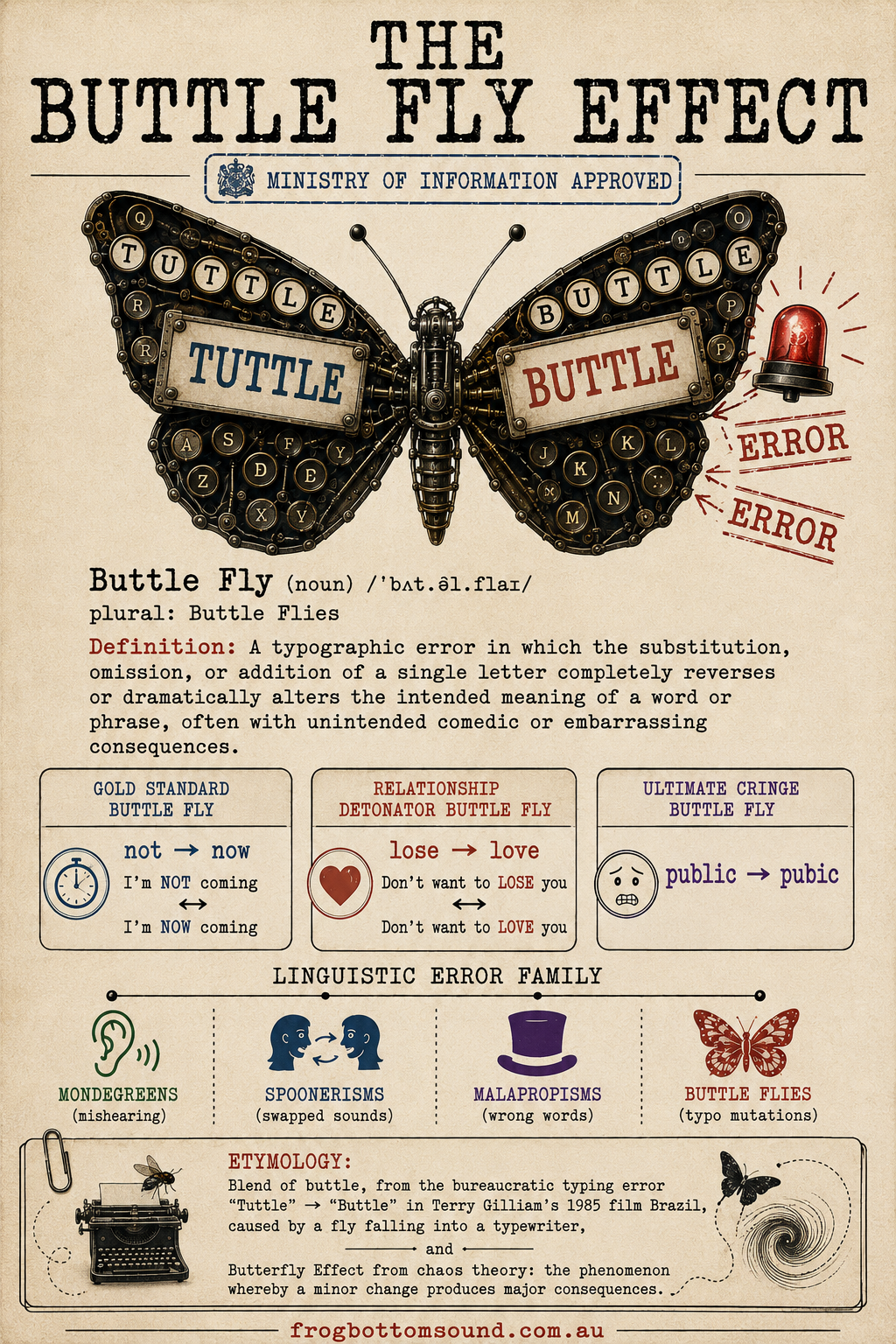
The Buttle Fly Effect
A typographic mutation with oversized consequences
Buttle Fly (noun)
plural: Buttle Flies
Definition: A typographic error in which the substitution, omission, or addition of a single letter completely reverses or dramatically alters the intended meaning of a word or phrase, often with unintended comedic or embarrassing consequences.
Etymology:
Blend of buttle, from the bureaucratic typing error "Tuttle" → "Buttle" in Terry Gilliam's 1985 film Brazil, caused by a fly falling into a typewriter,
and
Butterfly Effect from chaos theory: the phenomenon whereby a minor change produces major consequences.
Example: The email stating "I'm not coming to the meeting" became "I'm now coming to the meeting" due to a buttle fly, causing considerable confusion among attendees.
See also: mondegreen, spoonerism, malapropism, eggcorn
The Neologistic Inspiration
In 1954, the American writer Sylvia Wright published an essay in Harper’s Magazine called “The Death of Lady Mondegreen.” In it, she confessed a childhood mishearing of a line from the Scottish ballad “The Bonnie Earl o’ Moray.” The real lyric ends with “laid him on the green,” but Wright heard “Lady Mondegreen” and believed for years that a tragic noblewoman had been slain alongside the Earl.
From that single misheard syllable, she coined the term mondegreen — a name so perfect that it entered the language almost immediately. Wright identified a phenomenon and gave name. Today, mondegreens sit alongside spoonerisms, malapropisms, eggcorns.
Now to introduce a new member of that pantheon: The Buttle Fly Effect
Where a mondegreen is born of sound, a buttle fly is born of text. It’s the moment a when a single letter slips — through typing, dictation, autocorrect, or sheer human chaos — and the meaning of a sentence swerves into a different reality.
The name comes from the Terry Gilliam film Brazil, in which a single bureaucratic typo transforms the word “Tuttle” into “Buttle,” triggering an entire chain of unintended consequence, and the butter fly effect: the chaotic idea that a tiny change can produce a disproportionate outcome.
A buttlefly is the orthographic version of that principle — a micro‑mutation with macro‑impact.
Unlike ordinary typos, buttleflies don’t just distort meaning, they redirect it. They’re not simple mistakes, they’re semantic detonations: tiny slips that create alternate meanings and tangential worlds.
Gold Standard Buttle Fly: not → now
“I’m not coming” becomes “I’m now coming.”
Relationship Detonator Buttle Fly: lose → love
“I don’t want to lose you” becomes “I don’t want to love you.”
Ultimate Cringe Buttle Fly: public → pubic
A buttlefly that’s haunted school newsletters, council notices, and corporate memos for decades.
Buttle Flies caught in the wild:
We’ve had several retards rather than regards, down here.
When you go to text your friend a :) and and up asking them for :$
discovered by Stephan Rubenow Győry - Sunday June 28th, 2026